

The complete guide
Ultrasonic Retainer Cleaning: What Actually Gets Your Retainer Clean
A retainer sits against your teeth and gums for hours at a time, which means whatever collects on its surface stays in close contact with your mouth. Understanding what actually removes that build-up — and what just moves it around — makes the difference between a retainer that stays genuinely clean and one that looks clean but isn't.
Why brushing alone falls short
A toothbrush cleans flat, accessible surfaces well. A retainer is not flat: it has clasps, seams, textured acrylic and fine gaps around the wire, all of which trap plaque and bacteria that bristles simply cannot reach. Brushing alone tends to polish the visible surfaces while leaving the hidden ones untouched, which is why a retainer can look clean and still carry a smell or a film after a few days.
What ultrasonic cleaning actually does
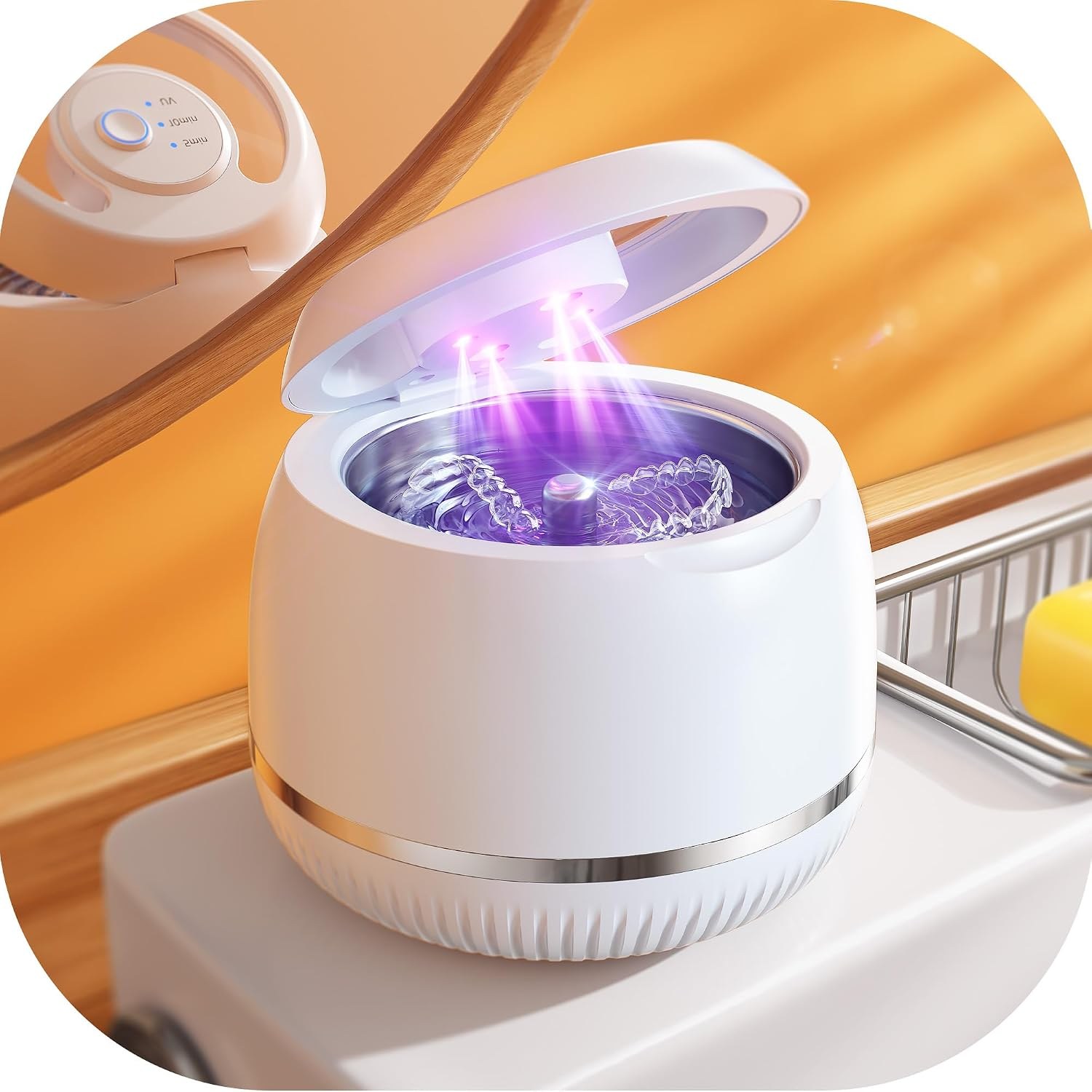
Ultrasonic cleaners work by generating high-frequency sound waves — 46kHz in the case of the Beser cleaner — through water. Those waves create millions of microscopic bubbles that form and collapse (a process called cavitation) against every submerged surface, including the gaps a brush can't enter. Each collapsing bubble releases a tiny burst of energy that lifts debris away from the surface. Because the water reaches everywhere at once, the whole appliance gets cleaned evenly, not just the parts facing outward.
Why dual-turbine matters
A single-transducer cleaner concentrates its cleaning action around one point in the tank, which can leave uneven results depending on exactly where an item sits. The Beser's two transducers spread that cavitation field more evenly through the full 200ml tank, so a retainer resting anywhere inside still gets thorough coverage.
Water alone vs. a cleaning tablet
Plain water and ultrasonic action together handle everyday build-up well. For visible staining, stubborn plaque or persistent odour, dissolving a cleaning tablet in the water before running a cycle adds a chemical cleaning action on top of the physical one, breaking down what cavitation alone leaves behind. A sensible routine is water for daily maintenance and a tablet-assisted cycle a few times a week, or whenever staining shows up.
Building it into a daily routine
The most effective habit is the simplest one: run a short cycle whenever you take your retainer out, whether that's overnight or during meals. A 5-minute cycle fits easily into a normal morning or evening routine, and doing it consistently prevents the kind of build-up that takes much longer to shift once it has set in.
Looking after the cleaner itself
Empty and rinse the tank after each use rather than leaving water sitting in it, and dry the tank before storing the unit. Occasional cycles with just water and no appliance inside help clear any mineral residue from the tank walls, especially in hard-water areas.
Buying with confidence
Ultrasonic cleaners are a category where marketplace listings can be inconsistent — the same photos and specifications sometimes get reused across different sellers offering different quality units. We check every cleaner in our range against its manufacturer's own listing before selling it, so the unit that arrives matches what's described, backed by its full manufacturer warranty.